
Amazon Continuous Education Mechanism
Amazon's Vendor Associate Support org needed a way to close skill gaps as they emerged — not months after they showed up in the data. I designed and personally maintained the mechanism behind the campaign; harnessing a coalition of cross-functional stakeholders who joined forces to bring the effort to life. I combined performance metrics and SOPs into responsive biweekly training, and biweekly training into measurable, trackable improvement.
AUDIENCE
188 Vendor Associates across the IN, EMEA, and NA regions, plus their supervisors.
RESPONSIBILITIES
Learning Experience Design
Mechanism Design & Ownership
Data Tracking and Analysis
Cross Functional Facilitation
TOOLS
Articulate 360 (Storyline/Rise)
Amazon Learn (AI Course Generation - Pilot)
Excel/Dashboards
Problem
Amazon's Vendor Associate Support organization had no routine way to evaluate its e-learning after launch or confirm it was actually closing the skill gaps it targeted. Stakeholders across Operations, Quality, and Learning were only loosely aligned, and by the time a gap showed up clearly in the data, it had often already cost weeks of avoidable errors.
Solution
Consulting the experts, I designed and personally maintained an evaluation mechanism that turned live defect data into biweekly training and biweekly training back into measurable results. A parallel tracking system verified data integrity between Learning and Operations, a pre-meeting rollup kept the whole cross-functional team aligned before each weekly review, and piloting Amazon's early-stage AI course-generation tool let me take a module from identified gap to live training within the same week.
The Mechanism
01
IDENTIFY THE GAP
Reviewed weekly TQM defect data to find which root-cause category was driving the most issues. Module 1 targeted a category responsible for 65% of all reported issues.
02
BUILD AND DEPLOY FAST
Piloted Amazon's early-stage AI course-generation tool, using SOPs and defect data to inform behavior driven course designs and builds; then hand-refined every draft myself; managing the support of another designer when needed — enabling same-week turnaround.
03
TRACK AND ITERATE
Maintained a personal tracker in parallel with Operations' dashboard, then brought verified, pre-shared metrics to a weekly review to decide the next module. Also gathered evaluative feedback for future module design in the pipeline.
DEFINE THE GOAL
A System, Not a One-Off
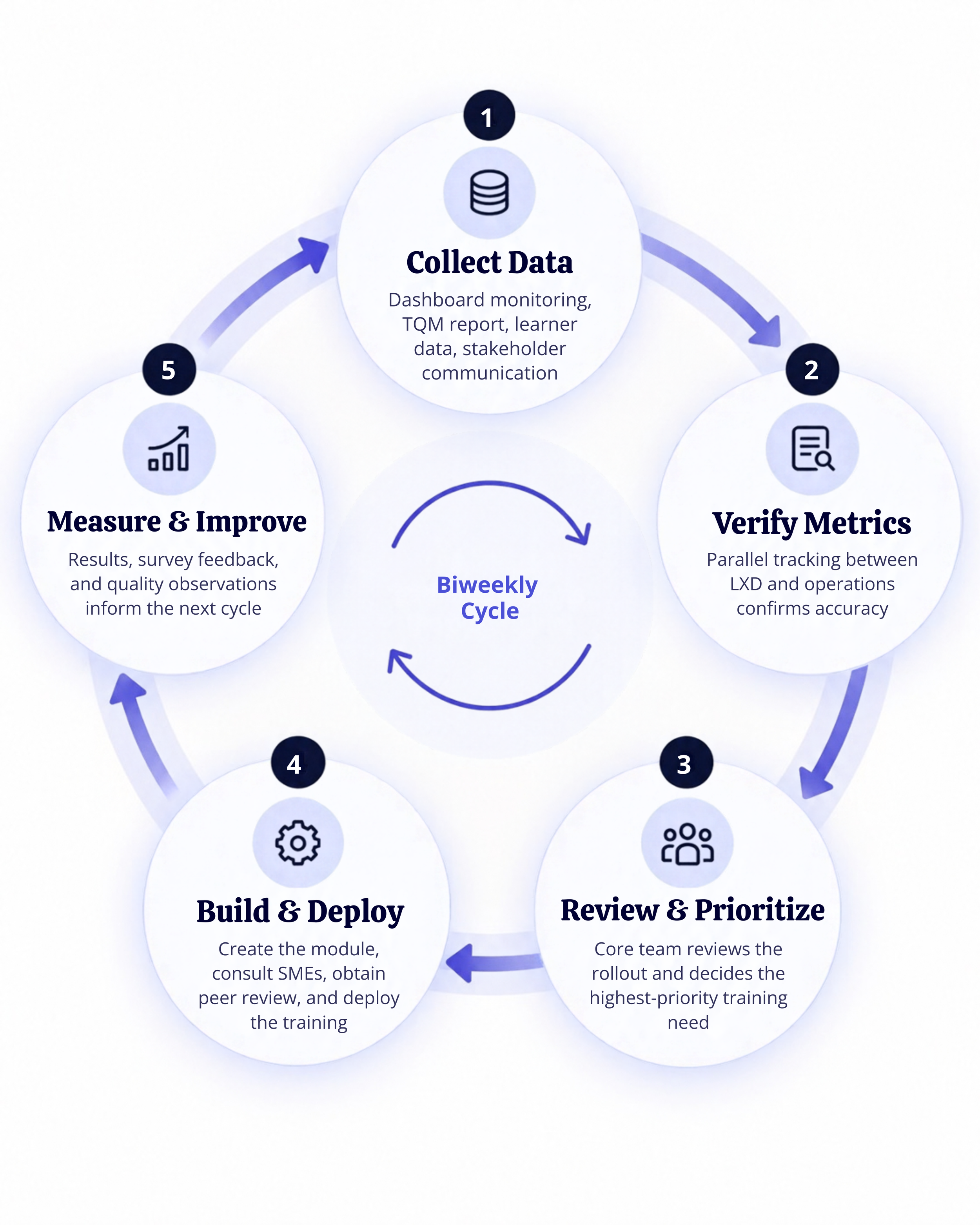
Amazon's Vendor Associate Support organization needed a repeatable way to evaluate recently deployed e-learning and keep a distributed, cross-functional team aligned on what to build next.
I designed the evaluation mechanism behind this myself, built on Amazon's internal “Mechanisms” framework — a structured approach pairing a Tool, an Adoption plan, and an Inspection routine.
My own tracker ran in parallel with the one our Vendor Supervisor maintained on the Operations side, so we could cross-verify completion data along with trending performance data before either of us brought it to the team.
A rollup document went out a full day before each weekly meeting, so the group could reflect on the numbers beforehand instead of processing them live.
DESIGN THE SOLUTION
Same-Week Turnaround, With a Tool Still Being Built
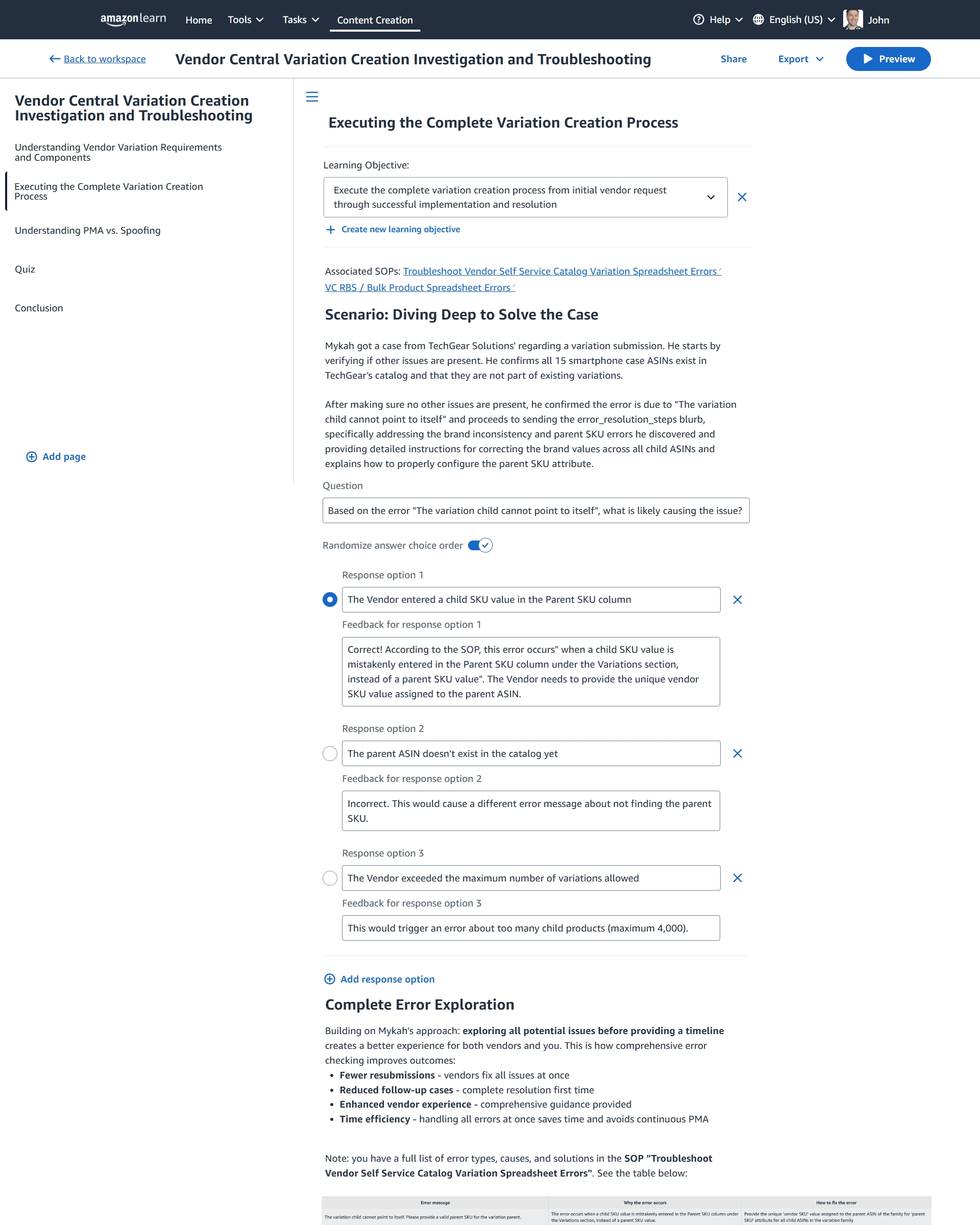
Because the whole point of the mechanism was responsiveness, speed mattered. I was selected to pilot Amazon Learn's AI course-generation software while it was still in early development — giving direct feedback to the engineering team on where its output fell short, and doing substantial hands-on work myself to shape raw AI-generated drafts into instructionally sound, behaviorally targeted modules.
That combination let me take a module from “this data point just emerged” to “live and assigned to learners” within the same week.

DEVELOP THE EXPERIENCE
From Data to Decision, Every Week
Every week, I brought verified learning and operational metrics to a standing review with our SPS Team Manager (final implementation authority), our Operations Manager (process consultation), our Vendor Supervisor (operational data), our Program Manager (representing Quality's real-world training needs), my Learning Experience Manager, our Vendor Education POC, and our SME and associate-facing advisor.
Together we decided what the next module should cover, and I built in a coaching path for any associate who failed an assessment three times, flagging them for a direct supervisor conversation.
IMPLEMENT AND EVALUATE
Implementation
The modules were issued biweekly I assigned them to the bottom quartile of associates based on performance. I sourced this data from my Ops contact and tracked completion using reports and dashboards to identify who still struggled to pass the assessment after three tries.
Those associates were assigned a differentiated version of the course; and were flagged for coaching conversations with their supervisors. I also provided facilitation resources and support for leaders to communicate with staff.
Evaluation
Evaluation of the module quality was measured through stakeholder and peer review, and sourcing ratings from our LMS platform with dialectical feedback included from EOC surveys on whether the courses were helpful, what learners wanted more of and how to improve the flow and accuracy of the trainings.
Feedback was routinely addressed during stand-ups with the Vendor Rangers to align on topmost priorities for flow and versioning the upcoming trainings. Findings showed that while SOPS were continuously evolving, there was a desire for downloadable reference guides and in person training materials to supplement.
Learner Satisfaction
4.8/5
IMPACT
Results — The first two months
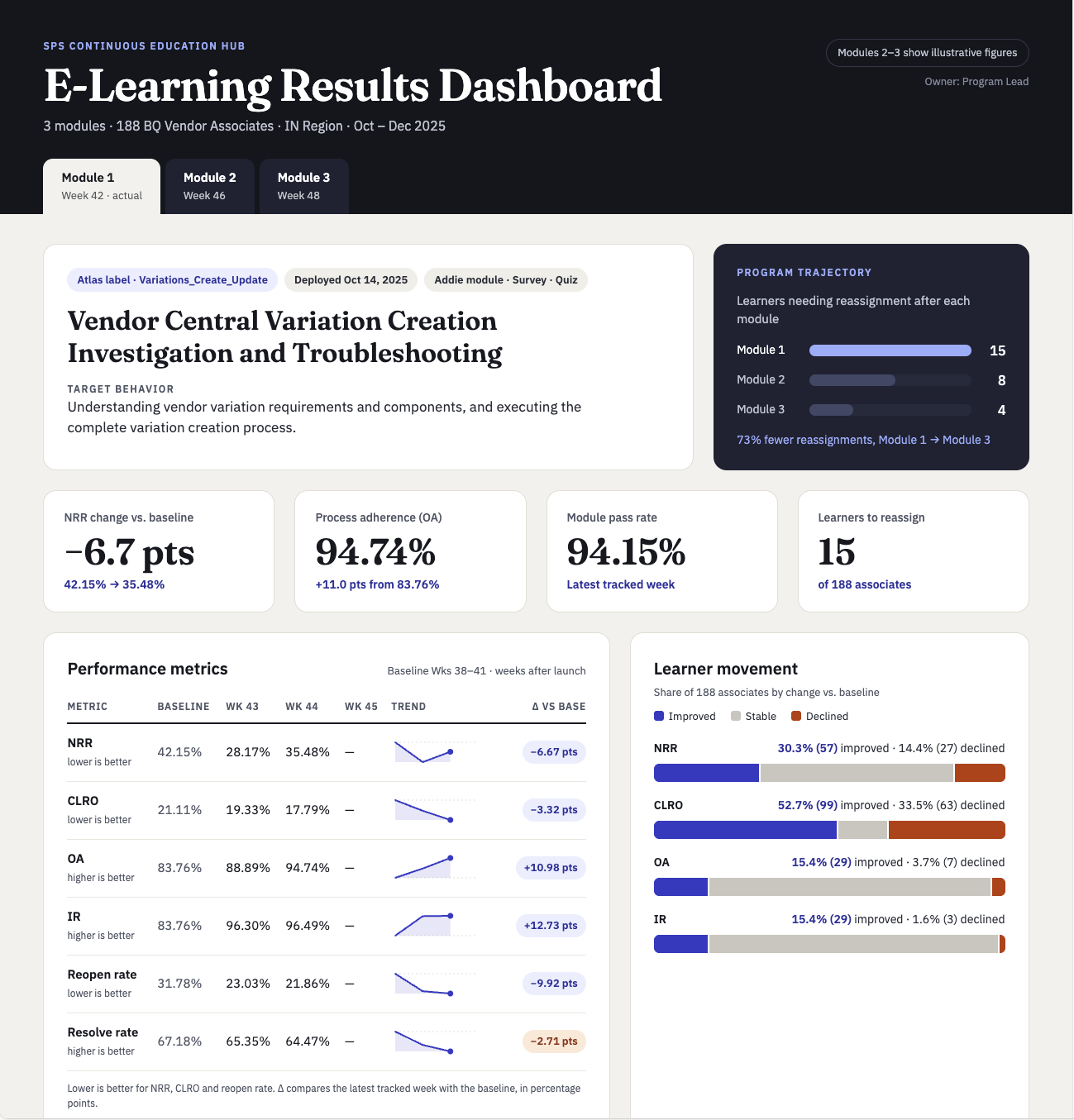
The data here represents the sustained impact of the intervention over time; representing the culmination of three modules, and their impact over the course of six weeks. In a report generated by data analytics; the effort was recognized for showing statistical significance as an effective intervention that showed real impact on the overall performance metrics for Vendor Support Associates at Amazon.
1,033 bps
NRR Improvement (Negative Response Rate) avg. from baseline
366 bps
CLRO Improvement (Case Level Reopens) avg. from baseline
903 bps
Outcome Accuracy Improvement avg. from baseline
903 bps
Outcome Accuracy Improvement avg. from baseline
903 bps
Outcome Accuracy Improvement avg. from baseline
Recognized Globally
In plain terms: after this training, vendor associates resolved issues correctly more often, needed fewer follow-up contacts to fix the same case, and left customers noticeably more satisfied — all within a few weeks of rollout. These results were strong enough that I was invited to present the program in person to our Vice President at Amazon's Seattle headquarters on the program and the results during our Global SPS Team Summit.
To see more projects visit my projects page!