Swatch Placement on Deeper Skin Tones
This was one of a series of modules developed for use in a curriculum collection designed to educate on the nuances of shade matching clients with deeper skin tones. Because FENTY leads so strongly with a message of inclusivity and options for all, this set of modules was top priority in driving behaviors conducive to selling products inclusively.
These games were designed for use by employees at Sephora to learn different aspects of makeup and selling beauty products.
AUDIENCE
RESPONSIBILITIES
Instructional Design
Storyboarding
Action Mapping
eLearning Development
TOOLS
Articulate Software
Adobe Photoshop
Adobe Illustrator
Microsoft Office Suite
Problem
A prevailing challenge in the beauty industry that has been historically under-acknowledged is the lack of diversity and nuanced foundation shades available for clients with deeper skin tones. Experiences in a space defined by narrow cultural representations have cause deep toned clients and retail sales staff alike to shy away from the conversation. This limits sales and conversion to the brand.
Solution
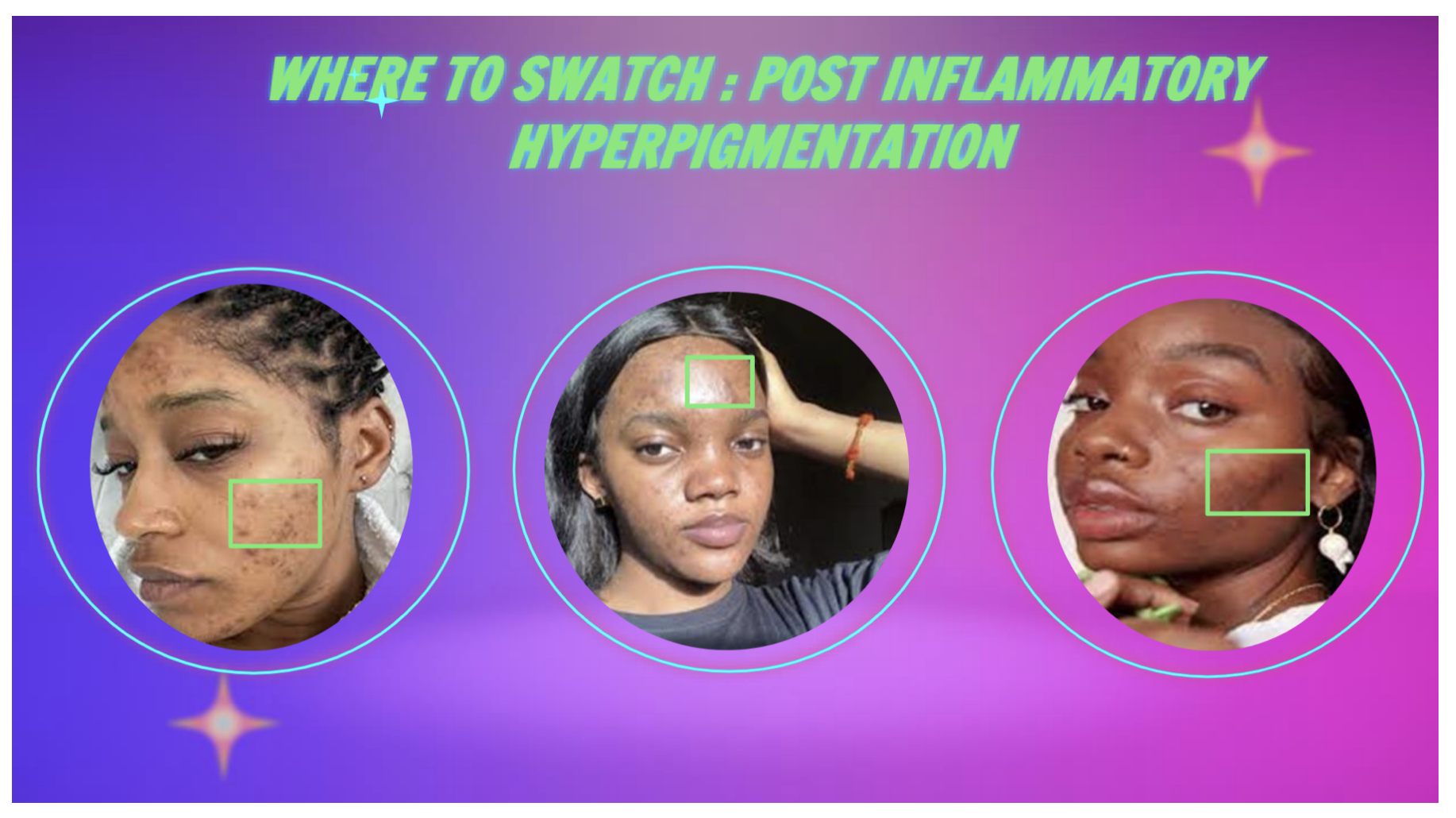
A set of modules was designed to convey objectives of: Identifying where to swatch on a deep skin tone client, learning how to identify an improper shade, and training on the various types of skin concerns that people with deeper complexions often have and how to speak to them with clients directly.
My Process
01
DEFINE THE GOAL
Through researching and action mapping, I analyze learner’s needs, identify key performance problems, and determine a series of high-priority actions to address these issues.
02
DESIGN THE SOLUTION
After identifying key actions, I create an immersive storyboard showcasing real-life problems and their consequences. I also create a prototype with all necessary visual and interactive elements.
03
DEVELOP THE EXPERIENCE
Once I receive feedback and have a signed-off prototype; I use authoring tools to develop the entire experience with a focus on every detail. This step includes extensive testing and iterations.
DEFINE THE GOAL
Research + Interviews
Kendo noticed the need to improve shade matching training at Sephora because efficient matching leads to higher sales.
I organized and observed shade matching sessions with professional trainers, and identified common mistakes through a poll among store leaders. I also went undercover at Sephora for a firsthand observation.
My analysis resulted in the creation of an outline of information and an action map to display the relation of the concepts being presented in the simplest and easy to digest format.
DESIGN THE SOLUTION
Text-based Storyboard
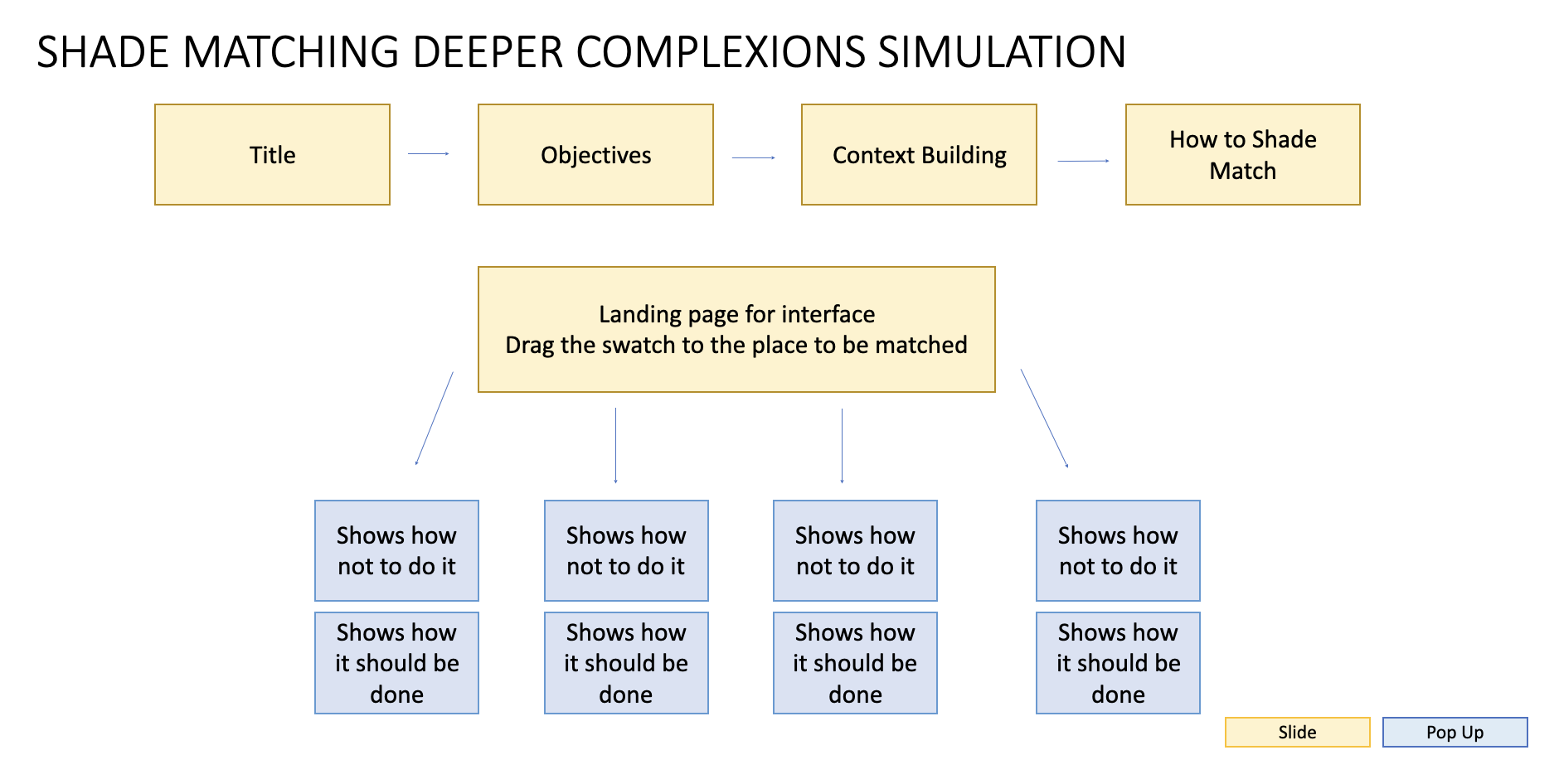
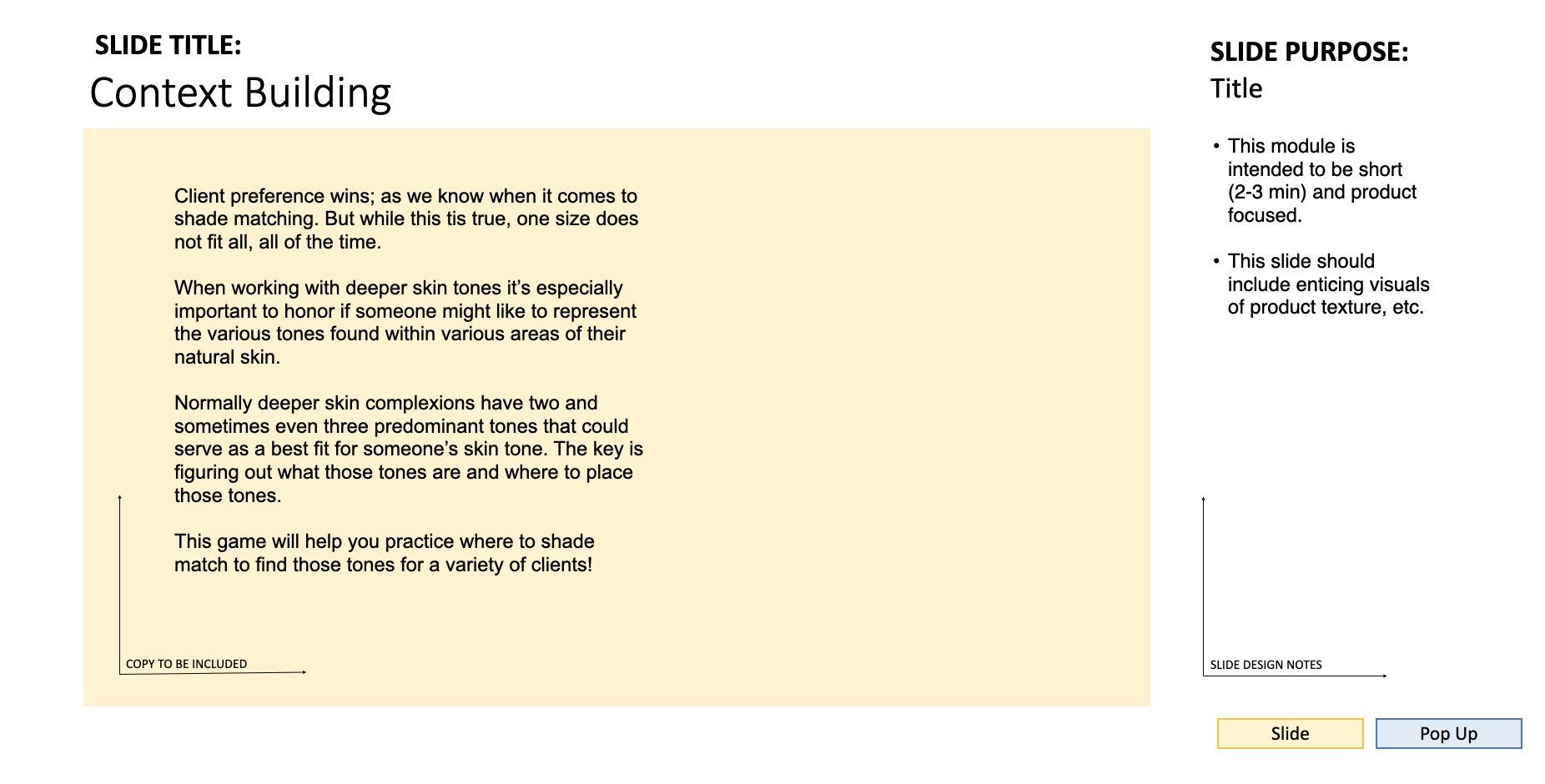
After distilling the research into steps and showcasing the flow of the learning, I created this text-based storyboard that offered options on how to expand upon the concepts and proposals for different educational strategies that could be used to present the info in an engaging format.
It also presented differentiated pathways for multiple learning styles and anticipated misconceptions to remedy potential learning gaps based on the prior research.
DEVELOP THE EXPERIENCE
Prototype + Reviews
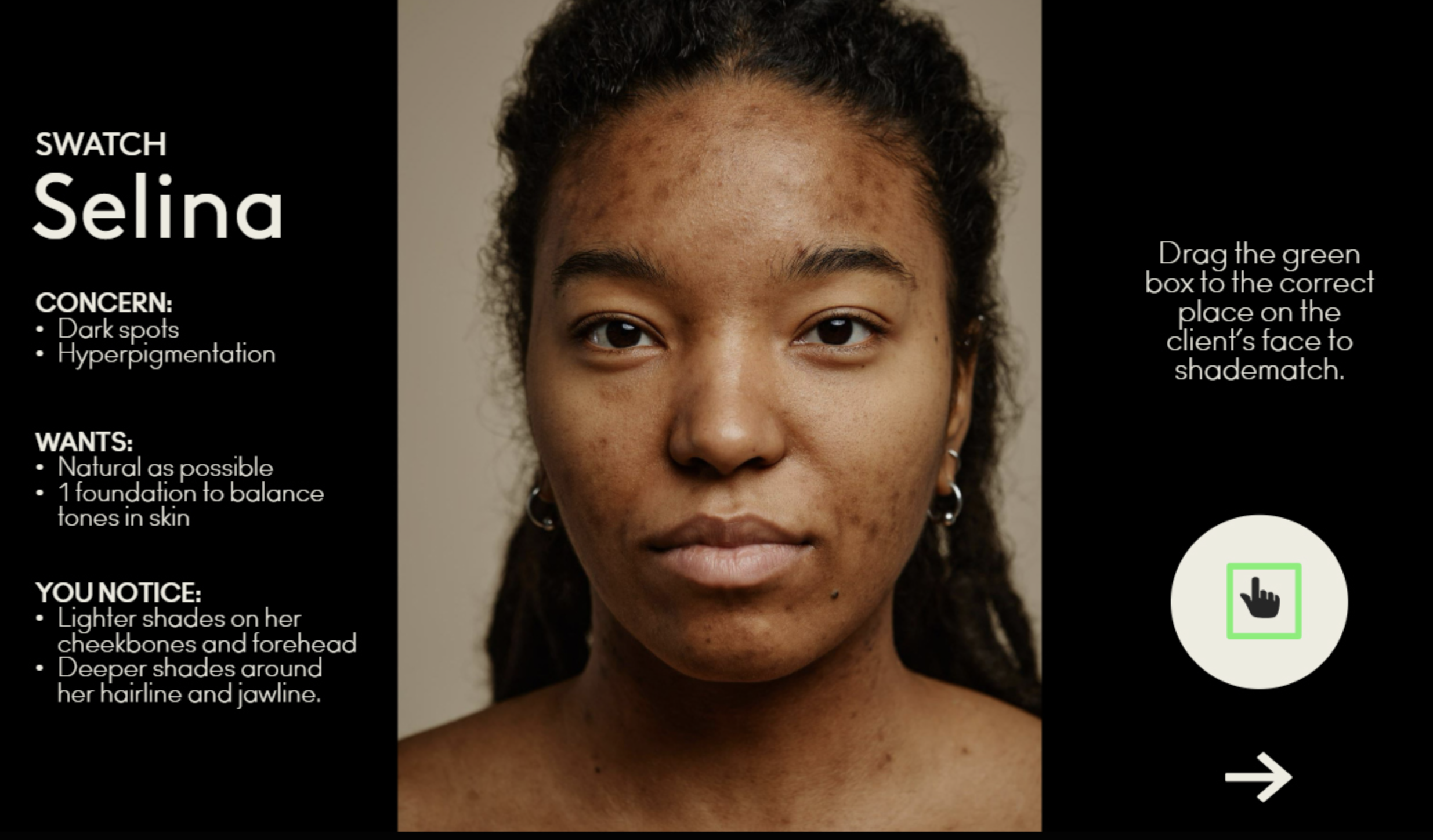
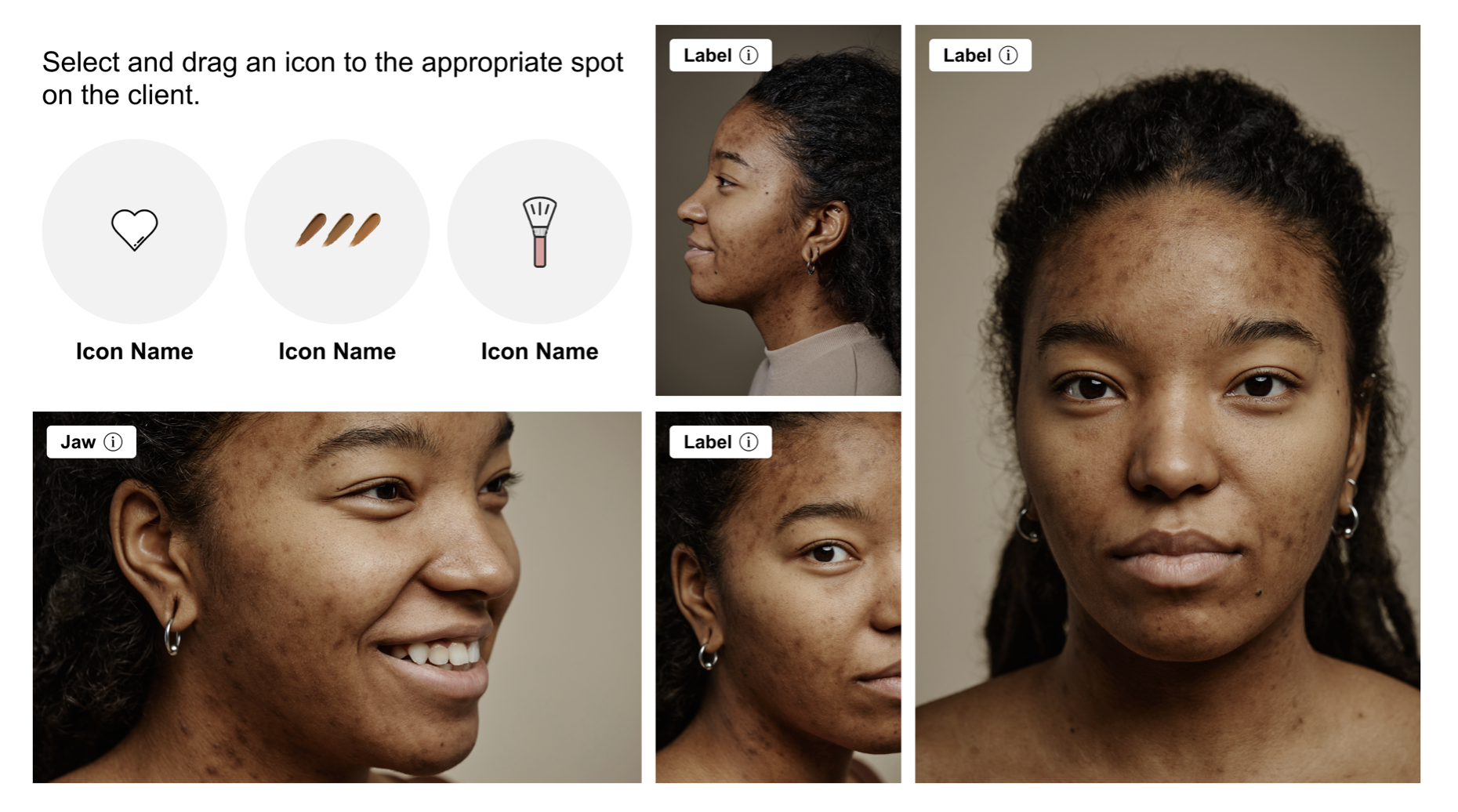
Upon aligning with stakeholders on the format of the e-learning, I built out a functional prototype that underwent several rounds of feedback to ensure that the product accurately represented the intended outcome.
The prototype evolved with consideration to shortening the copy, adjusting formatting for premium accessibility, and modifying the imagery included to showcase an optimally wide array of foundation shades for inclusivity.
RESULTS + TAKEAWAYS
Implementation
This module was launched on our company wide LMS and sent out to our global regions for translation and localization. Our team tracked retention to measure the efficacy of the e-learning at assessing the intended objectives.
Evaluation
Ten learners received follow-up emails with a survey asking them to rate the e-learning's real-life practicality, accuracy, and length. This module received an average of 3/3 stars for each category.